
How AI Governance Policies Can Protect Your Business: The Enterprise Shield
Unregulated “Shadow AI” adoption quietly exposes Australian enterprises to massive data leaks, intellectual property liabilities, and severe regulatory non-compliance. Implementing a structured AI Governance Policy mitigates these risks by locking down enterprise-grade environments, setting strict data ingestion rules, and mandating rigorous human verification.
Is your organisation inadvertently training public models with proprietary financials, internal source code, or sensitive client information through unmonitored employee usage? Without an enforced AI policy, how will your leadership defend a sudden data breach or structural compliance failure under Australian privacy regulations?
EduPulse Media
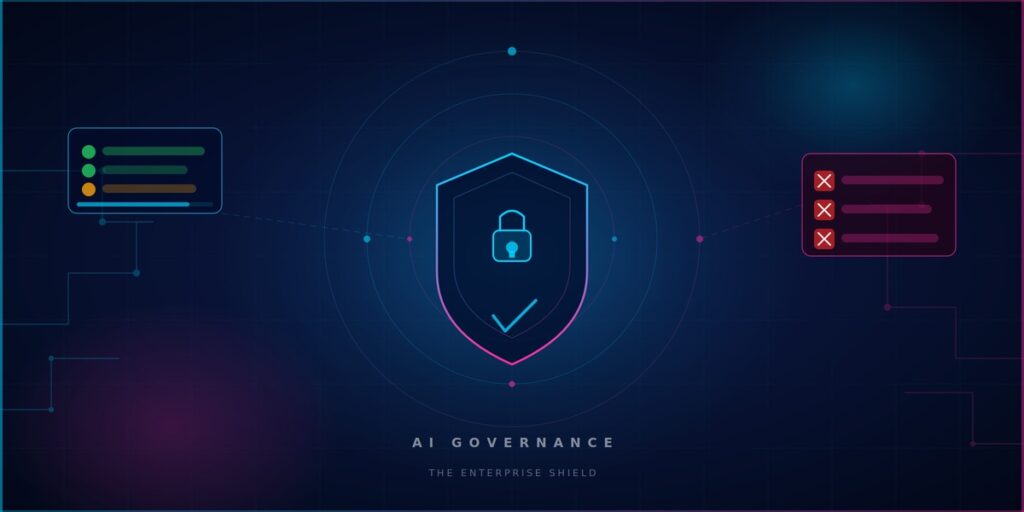
As Australian enterprises aggressively integrate machine intelligence into their daily operations, a critical structural risk has emerged. Ad hoc, unregulated tool adoption (often referred to as “Shadow AI” ) is quietly exposing organisations to severe data liabilities, copyright infringements, and regulatory penalties.
Without explicit boundaries, standard commercial activities can inadvertently compromise intellectual property and violate national privacy mandates. Implementing a rigorous AI Governance Policy is no longer an optional IT workflow; it is an absolute commercial necessity for safeguarding your corporate assets and ensuring operational continuity.
Below, we break down the three definitive pillars of corporate AI protection and how an engineered governance framework keeps your business secure, stable, and audit-ready.

Key Fact 1: Limiting and Restricting Access to Enterprise-Grade Solutions
The fastest way to leak proprietary corporate data is by allowing personnel to utilise free, consumer-facing generative applications. Standard public AI tools operate under terms of service that grant developers the right to ingest user prompts to train future iterations of their open models.
A robust AI Governance Policy solves this exposure vector by hardcoding strict access rules:
- Mandatory Enterprise Environments: Restricting employee access exclusively to dedicated Enterprise AI environments or locked API protocols featuring explicit data exclusion clauses.
- Prohibiting Open-Web Prompts: Banning the input of internal code bases, strategic financials, or client documentation into public consumer models.
- Commercial Indemnification: Standardising the use of platforms that offer legal and intellectual property protection, isolating your business from external copyright claims.
By shifting your architecture from open-source vulnerability to closed enterprise infrastructure, your operational data remains completely within your organisational boundary.
“AI governance isn’t about slowing your business down; it is the ultimate structural shield that prevents unregulated ‘Shadow AI’ from turning your proprietary data into a public liability.”
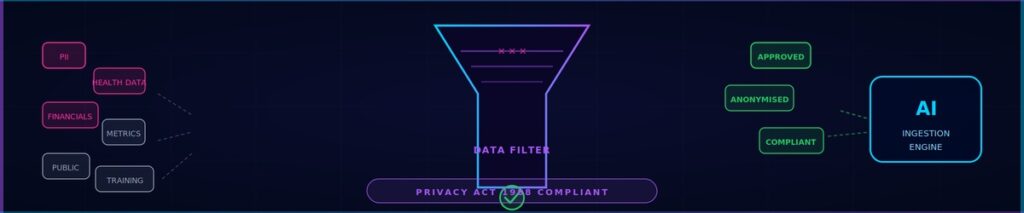
Key Fact 2: Defining Data Provenance. What Information Can Be Ingested?
Uncontrolled ingestion of data pipelines into custom machine models can lead to catastrophic compliance breaches under the Australian Privacy Act 1988. A functional governance structure acts as a strict filtering matrix, defining exactly what information is legally and technically fit for AI consumption.
A compliant policy enforces precise data boundaries:
- Absolute Exclusion of Sensitive Data: Restricting the ingestion of customer financial records, national identification numbers, health metrics, and protected demographic data.
- Non-Personal Data Prioritisation: Limiting the data pools for automated analysis to aggregated market metrics, public documentation, non-identified operational parameters, and internal training package materials.
- Anonymisation Frameworks: Requiring all corporate data sets to undergo forensic desensitisation and masking protocols before interacting with algorithmic processing pipelines.

Key Fact 3: Compulsory Training, Literacy, and the Verification Loop
An advanced software guardrail is useless if your workforce lacks the structural literacy to operate it safely. True risk mitigation requires combining software restrictions with comprehensive, ongoing team capability development.
Your governance framework should mandate an unyielding human-in-the-loop validation process:
- Compulsory AI Literacy Training: Upskilling all staff tiers in structured prompt engineering, algorithmic bias identification, and secure workflow execution.
- The “Human Verification” Mandate: Enforcing a strict operational rule that no automated output—whether it is an accredited learner resource, an analytical financial report, or customer-facing copy—can be published without manual verification and sign-off by a qualified internal specialist.
- Bias and Accuracy Audits: Scheduling routine, internal quality checks to identify and rectify model drift or hallucinations before they impact your brand equity or client delivery.
Turning Governance Into Market Capital
Deploying a comprehensive AI Governance Policy does not slow your organisation down; it accelerates your growth by removing execution friction. When your compliance, legal guardrails, and technology infrastructure are synchronised into a single, high-velocity system, your leadership team can innovate with absolute confidence.
Protect your digital perimeter, establish deep technical literacy, and turn automated systems into a secure, permanent, and highly scalable corporate asset.
More insights
Insights · 6 min read
AI Strategy & Governance
Protect your business, your people, and your future.
EduPulse Media
EduPulse Media is a full-stack consultancy and education ecosystem supporting vocational consulting, instructional design, AI strategy and digital growth.
© 2026 EduPulse Media. All rights reserved.